Every sales leader understands the relentless pursuit of growth. In today’s highly competitive landscape, simply having a great product or service isn’t enough. You need precise, actionable insights to guide your sales efforts, optimize strategies, and empower your team. This is where your Customer Relationship Management (CRM) system becomes an indispensable compass. It’s not just a database; it’s a goldmine of data waiting to be transformed into strategic advantage.
Yet, many sales teams barely scratch the surface of what their CRM can offer. They might track basic activities but miss the deeper performance indicators that truly reveal the health and potential of their sales engine. Understanding the Top CRM Metrics Every Sales Team Should Track is not just about measuring; it’s about predicting, improving, and ultimately, dominating your market. This comprehensive guide will delve deep into the essential sales performance indicators, explaining why they matter, how to track them, and what actionable insights they can provide to propel your team forward.
The Foundation of Sales Intelligence: Why CRM Metrics Matter More Than Ever
In the digital age, data is king. For sales organizations, this means moving beyond gut feelings and anecdotal evidence to embrace a data-driven approach. Your CRM system collects a vast amount of information about your prospects, customers, and sales activities. Ignoring this data is akin to navigating a ship without a compass – you might get somewhere, but it’s unlikely to be your intended destination efficiently.
Tracking the Top CRM Metrics Every Sales Team Should Track provides unparalleled visibility into your sales pipeline, individual rep performance, and overall business health. It allows you to identify bottlenecks, forecast revenue with greater accuracy, and make informed decisions about resource allocation and training. When you measure what matters, you can consistently refine your sales processes, leading to improved efficiency, higher win rates, and ultimately, sustainable revenue growth. It transforms sales from an art into a more precise science, enabling repeatable success.
Decoding Your Sales Funnel: Understanding Lead Conversion Rates
One of the most fundamental yet powerful Top CRM Metrics Every Sales Team Should Track is the Lead Conversion Rate. This metric reveals the percentage of leads that successfully transition from one stage of your sales funnel to the next, eventually becoming a paying customer. It’s not just about the final conversion to a customer; it’s about understanding the efficiency of each step.
Think about it: how many initial inquiries turn into qualified leads? How many qualified leads progress to a demo? And how many demos close into a deal? By tracking these granular conversion rates within your CRM, you gain profound insights into the effectiveness of your lead nurturing, qualification processes, and sales pitches at each stage. A low conversion rate at a specific stage signals a bottleneck that needs immediate attention, perhaps a flaw in your messaging or a gap in sales training. It’s the health check for your entire sales journey.
Optimizing Inbound Flow: Analyzing Lead Source Effectiveness
Knowing where your best leads come from is paramount for optimizing marketing spend and sales effort. Analyzing Lead Source Effectiveness is another one of the Top CRM Metrics Every Sales Team Should Track with diligence. Your CRM should be meticulously populated with information on how each lead originated – whether it was through a specific marketing campaign, a website inquiry, a referral, a cold call, or a trade show.
By categorizing and tracking lead sources, you can compare the quality and conversion rates of leads from different channels. Are your expensive paid advertising campaigns yielding high-converting leads, or are organic search leads proving to be more valuable in the long run? Perhaps referrals consistently lead to your most profitable customers. This metric empowers you to intelligently allocate your marketing budget and focus your sales team’s energy on the channels that deliver the highest ROI, ensuring you’re not just getting more leads, but getting better leads.
Speed and Responsiveness: Measuring Lead Response Time
In today’s instant gratification world, speed can make or break a deal. That’s why Lead Response Time stands out as a critical among the Top CRM Metrics Every Sales Team Should Track. This metric measures the time it takes for a sales representative to make initial contact with a new lead after it enters the CRM. Studies consistently show that the quicker you respond, the higher the likelihood of engaging and converting a lead.
Your CRM should automatically log when a lead is assigned and when the first activity (email, call, meeting) is recorded. A long lead response time often indicates a disconnect between marketing and sales, or an inefficient lead distribution process within the sales team. By actively monitoring and aiming to reduce this time, you ensure that hot leads don’t go cold and that your sales team capitalizes on prime opportunities before competitors do. It’s a direct measure of your team’s agility and commitment to seizing every potential opening.
Forecasting Precision: Tracking Sales Pipeline Value and Health
The sales pipeline is the lifeblood of any sales organization. Monitoring the Sales Pipeline Value and Health is undoubtedly one of the Top CRM Metrics Every Sales Team Should Track with extreme care. This metric gives you a snapshot of all potential deals currently in progress, categorized by their stage in the sales process and their estimated value. It’s your forward-looking indicator for future revenue.
A healthy pipeline isn’t just about total value; it’s also about its distribution across different stages. Is it top-heavy with early-stage leads but lacking in late-stage, high-probability deals? Or perhaps it’s too lean overall, indicating a future revenue dip. Your CRM’s pipeline management features allow you to visualize this data, identify potential gaps, and ensure a consistent flow of opportunities. Regular pipeline reviews, fueled by accurate CRM data, are essential for effective sales forecasting and resource planning, ensuring your team always has enough opportunities to hit their targets.
Efficiency at Every Stage: Analyzing Stage Conversion Rates
While overall lead conversion is important, a deeper dive into Stage Conversion Rates offers more nuanced insights, making it one of the most vital Top CRM Metrics Every Sales Team Should Track. This metric isolates the conversion rate between each specific stage of your sales pipeline. For example, what percentage of leads that move from “Discovery” to “Proposal” actually progress?
By examining these micro-conversions, you can pinpoint exactly where deals are stalling or falling out of the pipeline. Is your team struggling to move prospects from the “Demo” stage to “Negotiation”? This might suggest issues with presenting value, handling objections, or qualifying prospects effectively. Your CRM should provide the historical data needed to calculate these rates, allowing you to identify weak points in your sales process and develop targeted coaching or training programs to improve performance at those specific junctures.
The Rhythm of Success: Measuring Sales Cycle Length
Every product or service has an inherent sales cycle, the average time it takes for a lead to become a closed deal. Tracking Sales Cycle Length is a critical component of the Top CRM Metrics Every Sales Team Should Track for efficiency and predictability. This metric is calculated from the moment a lead enters your CRM to the point it’s marked as “Closed-Won.”
Understanding your average sales cycle length helps in accurate forecasting and resource planning. A sudden increase in sales cycle length might indicate new market challenges, increased competition, or a need to re-evaluate your sales process. Conversely, if certain reps consistently have shorter sales cycles with similar deal sizes, you can analyze their approach and replicate their best practices across the team. Your CRM provides the timestamps needed to rigorously track and analyze this crucial rhythm of your sales operation.
Maximizing Profitability: Focusing on Average Deal Size
While volume is important, the profitability of each deal significantly impacts your bottom line. Average Deal Size is another essential entry among the Top CRM Metrics Every Sales Team Should Track. This metric simply calculates the average revenue generated per closed-won deal over a specific period.
Monitoring this metric helps you understand if your team is effectively upselling, cross-selling, and targeting higher-value accounts. A declining average deal size could indicate a focus on smaller, less profitable clients, or a failure to demonstrate the full value of your offerings. Your CRM’s ability to categorize and track deal values allows you to segment this data by product, sales rep, or industry, providing insights into which strategies and segments yield the most lucrative outcomes. It’s about working smarter, not just harder, to boost overall revenue.
The Ultimate Measure: Tracking Sales Win Rate
Ultimately, the goal of sales is to win deals. The Sales Win Rate is perhaps the most celebrated among the Top CRM Metrics Every Sales Team Should Track, as it directly reflects your team’s effectiveness in converting opportunities into closed-won business. It’s calculated by dividing the number of won deals by the total number of opportunities over a given period.
A low win rate, despite a high volume of leads, points to significant issues in your sales process, from poor qualification to ineffective closing techniques. Your CRM is the source of truth for this metric, providing the historical data on both won and lost deals. Analyzing win rates by sales rep, product, industry, or even lead source can reveal powerful insights into what works and what doesn’t. It allows you to identify your top performers, understand their strategies, and provide targeted coaching to those who are struggling to convert opportunities into success.
Individual and Team Productivity: Monitoring Sales Activity Metrics
Beyond the big picture of won deals and pipeline value, understanding the underlying effort is crucial. That’s why monitoring Sales Activity Metrics is a non-negotiable part of the Top CRM Metrics Every Sales Team Should Track. This category includes tracking the number of calls made, emails sent, meetings booked, demos conducted, and proposals delivered by each sales representative.
Your CRM should be configured to automatically log these activities or make it incredibly easy for reps to record them. While activity alone doesn’t guarantee success, consistent activity is a prerequisite for generating opportunities. Analyzing these metrics helps identify whether reps are engaging in enough proactive outreach, or if they are spending too much time on administrative tasks. It also provides valuable data for coaching; if a rep has high activity but low conversion, it points to a need for skill development rather than just more effort.
Gauging Output and Effort: Analyzing Quota Attainment
Quota Attainment is the gold standard for measuring individual and team performance against set targets, making it one of the most straightforward yet critical Top CRM Metrics Every Sales Team Should Track. It calculates the percentage of a sales rep’s or team’s assigned revenue or activity quota that has been achieved within a specific period.
Your CRM should allow you to set and track individual and team quotas, providing real-time visibility into progress. Consistently low quota attainment indicates a need for strategic adjustments, whether it’s re-evaluating targets, improving sales training, adjusting lead flow, or addressing performance issues. High attainment celebrates success and provides benchmarks for best practices. It’s a direct measure of whether your sales force is meeting its revenue commitments and contributing to overall company goals.
Strategic Cost Management: Understanding Customer Acquisition Cost (CAC)
While sales teams are focused on bringing in revenue, it’s equally important to understand the cost associated with acquiring new customers. Customer Acquisition Cost (CAC) is a critical financial metric that falls under the umbrella of Top CRM Metrics Every Sales Team Should Track in collaboration with marketing and finance. It represents the total cost of sales and marketing efforts required to acquire one new customer.
While your CRM won’t directly calculate CAC on its own, it provides much of the raw data needed. By tracking the number of new customers acquired through your CRM and then integrating this with total sales and marketing spend (which should be influenced by lead source data from your CRM), you can derive this crucial metric. A high CAC might suggest inefficient marketing campaigns, a long sales cycle, or a need to optimize your sales process. Comparing CAC with Customer Lifetime Value (CLV) is essential for sustainable growth.
Sustaining Growth: Monitoring Customer Retention Rate
Sales isn’t just about closing new deals; it’s also about keeping the customers you already have. Customer Retention Rate, while often seen as a post-sales metric, is profoundly influenced by the initial sales process and customer experience, making it a crucial entry among the Top CRM Metrics Every Sales Team Should Track in collaboration with customer success. This metric measures the percentage of existing customers that remain customers over a specified period.
Your CRM, especially if integrated with billing or customer service systems, can track renewals, repeat purchases, and customer longevity. A high retention rate signifies customer satisfaction and a healthy relationship, often leading to upsells, cross-sells, and referrals. A low retention rate, on the other hand, is a red flag, indicating potential issues with product fit, customer service, or initial sales expectations. Understanding this metric helps sales teams focus on selling to the right customers and setting accurate expectations from the start, fostering long-term relationships rather than just short-term wins.
Long-Term Value: Calculating Customer Lifetime Value (CLV)
Customer Lifetime Value (CLV) is perhaps the ultimate forward-looking metric for sustainable business growth, and it certainly belongs on the list of Top CRM Metrics Every Sales Team Should Track for strategic sales planning. CLV estimates the total revenue a business can reasonably expect from a single customer account throughout their relationship.
While CLV calculation can be complex, your CRM provides essential data points: average deal size, average sales cycle, customer retention rates, and historical purchase data. By understanding which customer segments yield the highest CLV, your sales team can strategically prioritize their efforts, focusing on acquiring and nurturing relationships with customers who will generate the most long-term revenue. It shifts the perspective from single transactions to enduring partnerships, fundamentally changing how sales teams define success and allocate their resources.
The Silent Killer: Tracking Customer Churn Rate
The flip side of retention is churn, and tracking Customer Churn Rate is arguably one of the most critical Top CRM Metrics Every Sales Team Should Track to identify weaknesses in their customer relationships. Churn rate measures the percentage of customers who stop doing business with you over a given period. It’s revenue leaking from your business, often unnoticed until it’s too late.
Your CRM, especially when integrated with post-sales or billing systems, can provide the data to track lost accounts. High churn might indicate that sales are bringing in customers who aren’t a good fit, that customer expectations aren’t being met, or that there are issues with product satisfaction or customer support. By understanding churn, sales teams can refine their qualification processes, ensure they’re selling to truly compatible clients, and collaborate more effectively with customer success to prevent future losses. Proactive churn analysis can save significant revenue and resources in the long run.
Equipping Your Team: The Importance of Sales Enablement Effectiveness
Beyond just individual sales metrics, understanding the impact of your support systems is vital. Sales Enablement Effectiveness should be considered one of the Top CRM Metrics Every Sales Team Should Track indirectly, by correlating training, tools, and content usage with actual sales outcomes. This isn’t a single metric but a family of indicators that show how well your sales enablement efforts are paying off.
Your CRM can track the usage of sales collateral (presentations, case studies), training module completion, and even the adoption of new sales methodologies. By correlating these usage patterns with individual sales performance metrics like win rate, average deal size, or sales cycle length, you can ascertain whether your enablement initiatives are truly empowering your team. Are reps who utilize the latest battle cards closing more deals? Do reps who complete advanced product training demonstrate higher average deal sizes? This analysis ensures your investment in sales enablement is driving tangible results.
Driving Engagement: Monitoring CRM Adoption and Data Quality
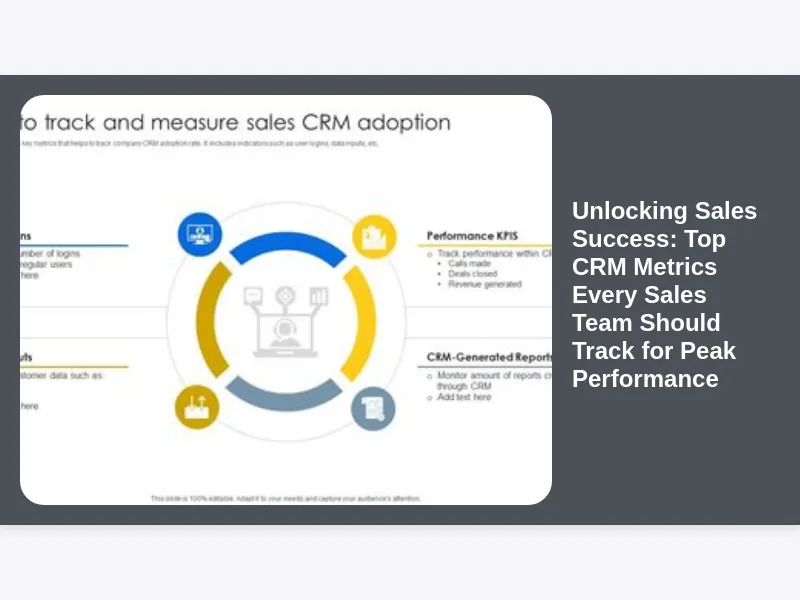
All the discussion about Top CRM Metrics Every Sales Team Should Track is moot if your sales team isn’t consistently using the CRM or if the data within it is inaccurate. Monitoring CRM Adoption and Data Quality is a foundational metric for the health of your entire sales operation. This means looking at how frequently reps log in, update records, and input critical information.
Your CRM should provide audit trails and activity logs that reveal user engagement. Look for patterns: are certain reps consistently behind on updates? Are there large gaps in data for specific accounts or opportunities? Low adoption or poor data quality directly impacts the reliability of all other sales metrics, making forecasting difficult and insights unreliable. Implementing strict data entry standards, providing ongoing training, and reinforcing the “why” behind CRM usage are critical for ensuring your data is clean, complete, and trustworthy.
Beyond the Numbers: Leveraging CRM for Coaching and Development
Merely tracking the Top CRM Metrics Every Sales Team Should Track isn’t enough; the true power lies in how you use that data for coaching and development. Your CRM provides a granular view of each sales representative’s performance, highlighting their strengths and areas for improvement. This allows sales managers to move beyond subjective assessments to data-driven coaching.
Imagine a scenario where a rep has a high number of activities but a low win rate. The CRM data immediately points to a need for skill development in qualification or closing, rather than just increasing activity. Conversely, a rep with a great win rate but a long sales cycle might need coaching on expediting deals. By leveraging the comprehensive metrics within your CRM, managers can tailor coaching sessions, provide targeted training, and develop personalized improvement plans, transforming average performers into top producers and sustaining the success of your elite sellers.
Avoiding Pitfalls: Common Mistakes in CRM Metrics Tracking
While striving to track the Top CRM Metrics Every Sales Team Should Track, it’s equally important to be aware of common pitfalls that can undermine your efforts. One frequent mistake is “analysis paralysis” – collecting too much data without knowing what to do with it, leading to overwhelming dashboards and inaction. Another is focusing solely on vanity metrics that look good but don’t provide actionable insights (e.g., total number of leads without regard to quality).
Ignoring data quality is perhaps the most egregious error; garbage in, garbage out. If your sales team isn’t diligently updating the CRM, any metric derived from that data will be misleading. Furthermore, chasing too many metrics at once can dilute focus. It’s better to select a core set of highly relevant metrics and master their interpretation before expanding. Finally, neglecting to act on the insights derived from your metrics renders the entire exercise pointless. Metrics are meant to drive change, not just provide a report card.
Future-Proofing Your Sales: The Role of AI in CRM Analytics
As technology continues to evolve, the way we track and interpret the Top CRM Metrics Every Sales Team Should Track is also advancing. Artificial Intelligence (AI) and machine learning are increasingly integrated into CRM platforms, revolutionizing sales analytics. AI can go beyond simple reporting to uncover hidden patterns, predict future outcomes, and even recommend next best actions.
Imagine an AI-powered CRM that not only shows you your current win rate but also predicts which deals are most likely to close, identifies at-risk accounts, or suggests optimal outreach times based on historical data. It can analyze vast datasets to pinpoint exactly where your sales process is most efficient or where it’s breaking down, far beyond what human analysis alone can achieve. Embracing these advanced analytical capabilities will be crucial for sales teams looking to maintain a competitive edge and make their CRM an even more powerful engine for growth.
The Continuous Improvement Cycle: Leveraging Metrics for Strategic Adjustment
Tracking the Top CRM Metrics Every Sales Team Should Track is not a one-time activity but an ongoing, iterative process that fuels continuous improvement. The data you collect and analyze should serve as the foundation for strategic adjustments across all facets of your sales organization. When a metric signals an issue, it’s an invitation to investigate, hypothesize solutions, implement changes, and then measure the impact of those changes.
For example, if your sales cycle length is increasing, you might re-evaluate your qualification criteria, streamline your proposal process, or introduce new sales tools. If your win rate for a particular product category is low, perhaps it’s time for more product training or a revised sales pitch. This disciplined approach of measure-analyze-adjust-re-measure creates a powerful feedback loop that ensures your sales strategies are always optimized for current market conditions and customer needs. It’s about building a learning organization, driven by empirical evidence.
Conclusion: Empowering Your Sales Force with Data-Driven Insights
In the competitive world of sales, knowledge is not just power; it’s profit. By diligently tracking the Top CRM Metrics Every Sales Team Should Track, sales leaders can transform their CRM from a mere data repository into a dynamic engine of growth and strategic advantage. These metrics provide the clarity needed to understand past performance, illuminate present challenges, and accurately forecast future opportunities.
From optimizing your lead funnel and improving individual sales rep performance to strategically managing costs and fostering long-term customer relationships, a data-driven approach empowers your sales team to work smarter, not just harder. Embrace the power of your CRM, commit to data integrity, and leverage these crucial metrics to build a resilient, efficient, and highly successful sales organization that consistently exceeds its targets and drives sustainable business growth.