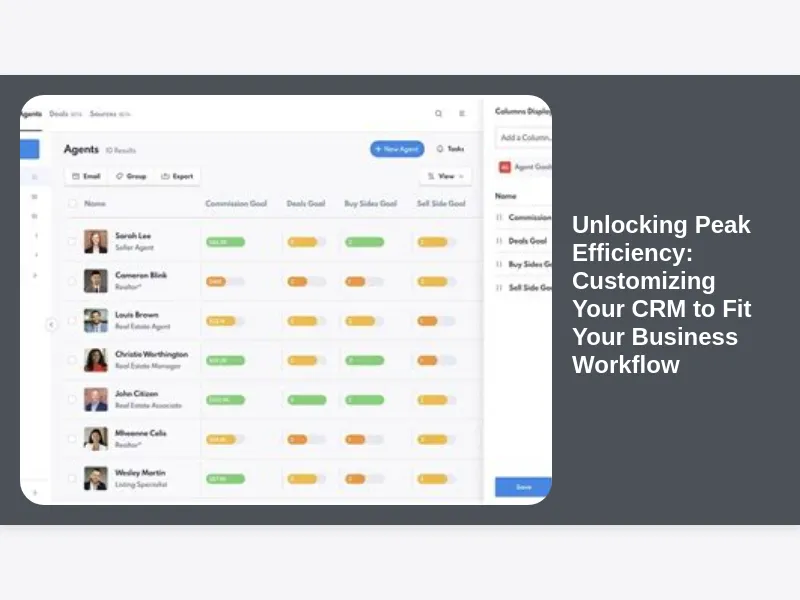
In today’s fast-paced business world, where every competitive edge counts, simply having a Customer Relationship Management (CRM) system might not be enough. Many businesses invest in powerful CRM platforms, only to find that their teams aren’t fully utilizing them, or that the system feels more like a hindrance than a help. The truth is, an off-the-shelf CRM, no matter how robust, often struggles to perfectly align with the unique rhythm and specific needs of your business.
This is where the transformative power of customizing your CRM to fit your business workflow comes into play. It’s not just about changing colors or adding a few fields; it’s about meticulously tailoring the software to mirror your operational processes, automate your unique tasks, and empower your teams to work more effectively and efficiently. Imagine a system that truly understands how your sales team sells, how your marketing team engages, and how your support team resolves issues – because it was built, or rather, adapted, specifically for them.
The Core Imperative: Understanding Your Unique Business Workflow
Before you even think about altering a single setting in your CRM, the absolute first step in customizing your CRM to fit your business workflow must be a deep dive into how your business actually operates. This isn’t just a superficial glance; it requires a comprehensive audit of your current processes, from the moment a lead enters your pipeline to the resolution of a customer service inquiry. Without this foundational understanding, any customization efforts risk being misdirected and ultimately ineffective.
Think about the journey your customers take, the specific steps your sales team follows, the information your marketing department needs, and the data your support staff relies on. Document these processes thoroughly, identifying every touchpoint, every handoff, and every piece of information exchanged. This diagnostic phase is crucial because it highlights both the strengths of your existing workflows and, more importantly, the pain points and inefficiencies that a customized CRM can address.
Beyond the Basics: Identifying Key Areas for CRM Customization
Once you have a clear picture of your operational landscape, you can start to pinpoint the specific areas within your CRM that demand attention. Customizing your CRM to fit your business workflow goes far beyond surface-level changes; it involves delving into the very architecture of the system to align it with your unique needs. This might include everything from how data is captured to how reports are generated.
The typical areas for deep customization often involve data structures, automation rules, user interfaces, and integration capabilities. Each of these components plays a vital role in ensuring that the CRM doesn’t just store information, but actively supports and enhances your team’s daily activities. Identifying these key areas early ensures that your customization project is focused and delivers maximum impact for your investment.
Tailored Data Management: Custom Fields and Modules for Precision
One of the most immediate and impactful ways to begin customizing your CRM to fit your business workflow is through the intelligent use of custom fields and modules. Generic CRM templates often come with a standard set of fields like “company name,” “contact number,” and “email address.” While these are essential, they rarely capture all the unique data points critical to your business.
Perhaps your business deals with specific product configurations, regulatory compliance information, or unique customer preferences that aren’t covered by standard fields. Creating custom fields allows you to capture this specific data directly within the CRM, ensuring that all relevant information is centralized, searchable, and actionable. Similarly, if your business has distinct operational entities or specific processes that don’t neatly fit into standard “leads,” “contacts,” or “accounts,” custom modules can be developed to manage these unique data sets, providing a truly bespoke data management solution.
Automating Success: Streamlining Operations with CRM Workflow Automation
The true power of customizing your CRM to fit your business workflow becomes incredibly apparent when you start implementing advanced automation. Many business processes are repetitive and time-consuming, from sending follow-up emails to updating record statuses. These tasks, while necessary, can detract significantly from your team’s ability to focus on high-value activities like engaging with customers.
By designing and configuring custom workflow rules within your CRM, you can automate a vast array of these routine tasks. Imagine a scenario where a lead automatically progresses to the next sales stage once a specific email is opened, or a support ticket is escalated to a manager if it remains unresolved for a certain period. This kind of intelligent automation not only saves countless hours but also reduces human error, ensuring consistency in your operations and significantly boosting overall productivity across your sales, marketing, and customer service departments.
Seamless Connectivity: Integrating Your CRM with Existing Business Systems
In today’s interconnected digital ecosystem, no single software solution operates in isolation. A critical aspect of customizing your CRM to fit your business workflow involves establishing seamless integrations with other essential business systems you already use. This could include your accounting software, email marketing platforms, enterprise resource planning (ERP) systems, customer service ticketing tools, or even your internal communication platforms.
When your CRM communicates effectively with these other systems, it eliminates data silos and reduces the need for manual data entry, which is a common source of errors and inefficiency. For example, syncing customer data between your CRM and your accounting system ensures that sales figures and payment statuses are always up-to-date and accessible to relevant teams. These integrations create a unified view of your customer and business operations, ensuring that all departments are working with the most current and accurate information, leading to more informed decisions and a more cohesive customer experience.
User Experience Transformation: Customizing the CRM Interface for Optimal Adoption
Even the most powerful CRM will fail if your team finds it cumbersome or difficult to use. Therefore, a crucial, yet often overlooked, component of customizing your CRM to fit your business workflow is tailoring the user interface (UI) and user experience (UX). This isn’t just about aesthetics; it’s about simplifying navigation, organizing information logically, and presenting data in a way that is intuitive and relevant to each user’s role.
Consider customizing dashboards to display key performance indicators (KPIs) relevant to a sales manager, while a support agent sees their open tickets and customer history immediately upon logging in. Streamlining data entry forms by removing unnecessary fields and highlighting crucial ones can significantly improve user efficiency and reduce frustration. When the CRM feels natural and effortless to use, adoption rates soar, and your team spends less time fighting with the software and more time engaging with customers and closing deals.
Empowering Insights: Customized Reporting and Analytics for Strategic Decisions
Data is the new oil, and a customized CRM is your refinery, turning raw data into actionable insights. A generic CRM might offer standard reports, but these often fall short of providing the specific, granular information critical for your unique business strategy. Therefore, a key benefit of customizing your CRM to fit your business workflow is the ability to generate highly personalized reports and dashboards.
Imagine being able to track sales performance by specific product lines, analyze customer churn rates based on unique service interactions, or measure the effectiveness of marketing campaigns tied to very particular customer segments. Customized reporting allows you to visualize the data that matters most to your business, in the format that makes the most sense. This capability empowers leadership to make data-driven decisions, identify emerging trends, spot bottlenecks, and refine strategies to optimize every aspect of your customer relationship management.
Protecting Your Assets: Implementing Robust Security and Permissions in Your Custom CRM
Data security and privacy are paramount in today’s business environment. As you embark on customizing your CRM to fit your business workflow, it’s imperative to meticulously define and implement robust security settings and permission structures. Not every user needs access to every piece of information, and controlling who can view, edit, or delete specific data is vital for compliance, data integrity, and protecting sensitive customer information.
Your customized CRM should allow you to create granular permission roles, ensuring that sales representatives only see their own leads, managers can view their team’s performance, and financial data is restricted to authorized personnel. This not only safeguards your valuable data but also streamlines the user experience by presenting only the relevant information to each individual, reducing clutter and potential for error. A well-designed security framework is a cornerstone of a trustworthy and efficient custom CRM.
The Human Element: Training and Change Management for a Smooth Transition
Implementing a customized CRM is not merely a technological upgrade; it’s a significant organizational change. Even the most perfectly customized CRM to fit your business workflow will falter if your team isn’t adequately prepared, trained, and brought along on the journey. Change can be daunting, and initial resistance is natural, which is why a robust change management strategy is as crucial as the technical implementation itself.
This involves clear communication about why the changes are being made, what benefits they will bring to individual roles, and providing comprehensive training programs tailored to different user groups. Hands-on workshops, accessible documentation, and ongoing support channels are essential to ensure that employees feel confident and proficient in using the new system. Embracing the human element ensures high adoption rates and leverages your investment to its fullest potential.
Future-Proofing Your Investment: Designing for Scalability and Adaptability
The business landscape is constantly evolving, and your CRM needs to evolve with it. When you’re customizing your CRM to fit your business workflow, it’s vital to design with future growth and adaptability in mind. What works perfectly today might need adjustments as your company expands into new markets, introduces new products, or alters its operational model. A rigid, overly specific customization can become a bottleneck rather than an asset.
Think about scalability in terms of data volume, user growth, and the flexibility to add new modules or integrations without a complete overhaul. Choose a CRM platform that offers a solid foundation for future customizations and has a strong developer community or marketplace for add-ons. Building in flexibility from the outset ensures that your custom CRM remains a valuable, long-term asset, capable of supporting your business’s dynamic journey for years to come.
Navigating the Customization Journey: When to Seek Expert Help
While many modern CRM platforms offer intuitive customization tools, the process of truly customizing your CRM to fit your business workflow can become complex, especially for businesses with intricate processes or unique integration needs. This is where the expertise of a CRM consultant or specialized developer becomes invaluable. They bring a wealth of experience from various industries and can offer strategic guidance that goes beyond mere technical implementation.
These experts can help you thoroughly analyze your workflows, identify optimal customization strategies, design complex automations, develop custom integrations, and even provide tailored training. Engaging a professional ensures that your customization project is executed efficiently, adheres to best practices, and avoids common pitfalls that can lead to costly rework or suboptimal performance. It’s an investment that often pays for itself through increased efficiency and a more robust, future-ready CRM system.
Measuring the Impact: Calculating the ROI of Your Customized CRM
Every significant business investment requires a clear understanding of its return on investment (ROI). Customizing your CRM to fit your business workflow is no exception. Quantifying the benefits can solidify internal buy-in and justify the resources allocated to the project. The ROI of CRM customization isn’t always immediately obvious in terms of direct revenue; it often manifests through efficiency gains, reduced costs, and improved customer satisfaction.
Consider metrics such as reduced time spent on manual data entry, faster sales cycles, increased lead conversion rates, lower customer churn, improved customer service resolution times, and enhanced employee productivity. By tracking these key performance indicators before and after your customization efforts, you can clearly demonstrate the tangible value your tailored CRM brings to the organization. This data-driven approach allows you to continuously refine your CRM strategy and ensure ongoing value.
Common Pitfalls to Avoid: Ensuring a Successful CRM Customization Project
While the benefits of customizing your CRM to fit your business workflow are immense, there are several common pitfalls that businesses should actively strive to avoid. One of the most significant is insufficient planning and failing to thoroughly understand existing workflows before diving into changes. Without a clear roadmap, customizations can become haphazard and counterproductive, potentially creating more problems than they solve.
Another common mistake is over-customization, where the system becomes overly complex or brittle, making future updates or maintenance challenging. Neglecting user training and change management is also a frequent pitfall, leading to low adoption rates and user frustration. Finally, failing to consider scalability and future needs can result in a CRM that quickly becomes obsolete as your business grows. Proactive planning, user involvement, and a phased approach can help mitigate these risks.
Choosing the Right Foundation: CRM Platforms Built for Flexibility and Customization
The success of customizing your CRM to fit your business workflow heavily depends on the underlying CRM platform you choose. Not all CRM systems are created equal in terms of their customizability. Some are designed as highly flexible, open platforms, while others are more rigid, offering limited options for tailoring. Platforms like Salesforce, Microsoft Dynamics 365, Zoho CRM, and HubSpot Enterprise are often cited for their robust customization capabilities, though each has its own strengths and nuances.
When selecting a CRM, look for features such as extensive API access for integrations, a rich marketplace of third-party applications, a powerful workflow automation engine, and the ability to create custom objects, fields, and layouts without requiring extensive coding. A platform that provides both low-code/no-code tools for business users and advanced development environments for IT professionals offers the best balance for comprehensive and sustainable customization.
Case Study Snapshots: Real-World Success Stories of Tailored CRM Implementations
To truly appreciate the impact of customizing your CRM to fit your business workflow, let’s consider hypothetical examples that mirror real-world successes. Imagine a specialized manufacturing company that historically struggled with tracking unique product configurations and complex sales cycles. By customizing their CRM with specific product hierarchy modules, custom approval workflows for quotes, and integrations with their CAD software, they dramatically reduced sales cycle times and order errors.
Another example could be a non-profit organization that needed to manage diverse donor relationships, volunteer schedules, and grant applications, none of which fit a standard sales-centric CRM. Through extensive customization, including bespoke donor management modules, automated communication sequences based on engagement levels, and integrated grant tracking, they significantly improved donor retention and streamlined their fundraising efforts, ultimately increasing their impact. These scenarios highlight how a tailored approach unlocks specific, tangible benefits unique to each organization.
The Road Ahead: Continuously Evolving Your Custom CRM for Sustained Growth
The journey of customizing your CRM to fit your business workflow isn’t a one-time project; it’s an ongoing process of refinement and evolution. As your business grows, adapts to market changes, or introduces new services, your workflows will naturally shift. A truly effective customized CRM is one that can continuously adapt to these changes, ensuring it remains a relevant and powerful tool for achieving your strategic objectives.
Regular reviews of your CRM’s performance, soliciting feedback from users, and proactively identifying new opportunities for optimization are crucial. This might involve minor adjustments to existing workflows, the introduction of new automation rules, or even the development of entirely new modules to support emerging business needs. By adopting a mindset of continuous improvement, your custom CRM will remain a dynamic asset that propels your business forward, not holds it back.
Conclusion: Your Business, Perfectly Powered by a Custom-Fit CRM
In an increasingly competitive landscape, where efficiency and customer experience are paramount, relying on a generic CRM system simply won’t cut it. The true competitive advantage comes from a system that is intricately woven into the fabric of your organization, a system that understands and supports your unique rhythm. Customizing your CRM to fit your business workflow transforms it from a mere database into a strategic asset – a dynamic engine driving sales, enhancing customer relationships, and streamlining operations.
By taking the time to understand your workflows, strategically implement tailored solutions, automate repetitive tasks, integrate seamlessly with other systems, and empower your users, you unlock the full potential of your CRM investment. This personalized approach leads to higher user adoption, greater data accuracy, profound operational efficiencies, and ultimately, a more agile and profitable business. Embrace the power of customization, and watch your business thrive with a CRM that’s truly built for you.