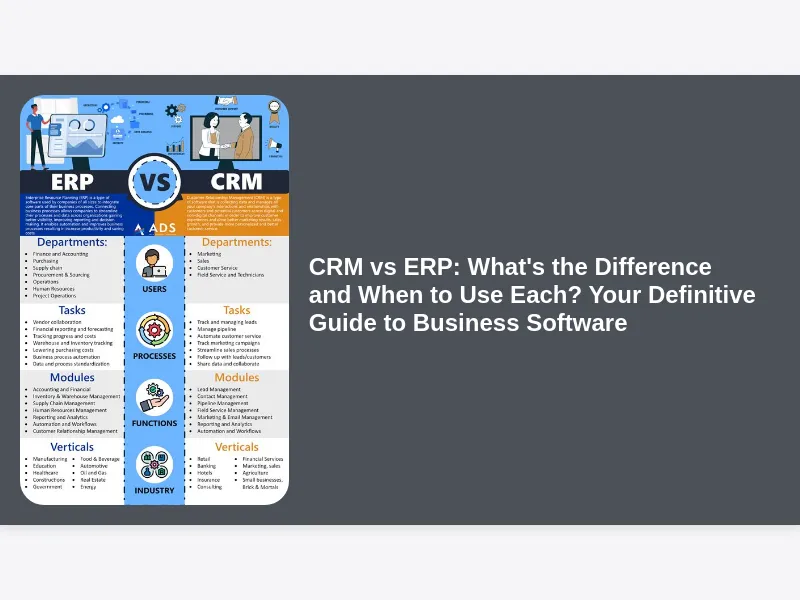
In today’s fast-paced business landscape, technology is no longer just a tool; it’s the very backbone of operational efficiency, customer engagement, and strategic growth. Companies, both big and small, are constantly seeking ways to streamline processes, understand their customers better, and make data-driven decisions. This quest often leads them to explore powerful business software solutions like Customer Relationship Management (CRM) and Enterprise Resource Planning (ERP) systems. While both are indispensable for modern enterprises, their purposes, functionalities, and impact on an organization differ significantly.
Navigating the world of business software can be complex, and it’s easy to confuse CRM and ERP due to their shared goal of improving business performance and their ability to handle vast amounts of data. However, understanding the distinct focus of each system is crucial for making informed investment decisions that truly align with your company’s specific needs and strategic objectives. This comprehensive guide will demystify the core distinctions between CRM and ERP, highlight their unique benefits, explore scenarios where each system shines, and provide insights into how they can synergize to propel your business forward. Let’s embark on this journey to uncover the true power of these enterprise solutions.
Understanding CRM: Customer Relationship Management Explained
At its core, CRM, or Customer Relationship Management, is a technology system designed to manage and analyze customer interactions and data throughout the customer lifecycle. Its primary objective is to improve business relationships with customers, assist in customer retention, and drive sales growth. Think of a CRM as your digital hub for all things related to your customer base – from their very first interaction with your brand to ongoing support and beyond. It’s about building stronger, more meaningful, and more profitable relationships.
A CRM system gathers, organizes, and manages all customer information in one centralized database. This includes contact details, communication history (emails, calls, social media interactions), purchase records, service requests, and even preferences. By consolidating this data, CRM empowers sales teams to track leads and opportunities, marketing teams to execute targeted campaigns, and customer service departments to provide personalized and efficient support. It shifts the focus squarely onto the customer, aiming to enhance their experience at every touchpoint.
The essence of CRM lies in its ability to provide a 360-degree view of the customer. Imagine a sales representative preparing for a call; with a CRM, they can instantly access the customer’s entire history, previous interactions, outstanding issues, and even personal notes, allowing for a highly personalized and informed conversation. This level of insight not only improves customer satisfaction but also significantly boosts the effectiveness of sales and marketing efforts. It’s about turning fragmented data into actionable intelligence that fosters loyalty and drives revenue.
Beyond just managing interactions, a robust CRM system also offers powerful analytical capabilities. It can track customer behavior, identify trends, forecast sales, and measure the effectiveness of various marketing strategies. This analytical power allows businesses to proactively identify potential issues, capitalize on emerging opportunities, and continually refine their customer engagement strategies. Ultimately, a CRM is an investment in your customer relationships, designed to make them more efficient, more profitable, and more enduring.
Core Components of a CRM System: Enhancing Customer Engagement
A comprehensive CRM system isn’t just one monolithic application; rather, it’s a suite of interconnected functionalities designed to cover every aspect of the customer journey. Understanding these core components is essential to grasp the breadth of what CRM can achieve for your business. These modules work in harmony to ensure that every customer interaction is managed effectively, from initial contact to long-term loyalty.
One of the foundational components is Sales Force Automation (SFA). This module streamlines the entire sales process, from lead generation and qualification to opportunity management, quoting, and order placement. It automates repetitive tasks, tracks sales pipelines, sets reminders for follow-ups, and provides sales representatives with the tools they need to close deals more efficiently. By centralizing lead information and tracking progress, SFA ensures that no potential sale falls through the cracks and that sales teams are always focused on high-priority activities.
Another critical module is Marketing Automation. This component helps businesses design, execute, and analyze targeted marketing campaigns across various channels, including email, social media, and web. It enables segmentation of customer lists, personalization of marketing messages, and scheduling of automated workflows, such as welcome emails or abandoned cart reminders. Marketing automation within CRM ensures that the right message reaches the right customer at the right time, nurturing leads and driving conversions more effectively.
Customer Service and Support is perhaps one of the most visible components of a CRM. This module manages all aspects of customer inquiries, issues, and support requests. It typically includes features like ticketing systems, knowledge bases, live chat, and case management. By centralizing service requests and providing agents with a complete view of the customer’s history, this component ensures faster resolution times, consistent support, and ultimately, higher customer satisfaction. It transforms customer service from a cost center into a powerful tool for retention and advocacy.
Finally, Analytics and Reporting are integral to a modern CRM. This component transforms raw customer data into actionable insights through customizable dashboards, performance metrics, and detailed reports. It allows businesses to track sales performance, analyze marketing campaign effectiveness, monitor customer service metrics, and identify key trends. These insights are invaluable for strategic planning, identifying areas for improvement, and making data-driven decisions that enhance customer relationships and drive business growth.
Benefits of Implementing CRM Solutions: Driving Sales and Satisfaction
The decision to implement a CRM system is often driven by a desire to address specific challenges related to customer interaction and revenue growth. The benefits that accrue from a well-executed CRM strategy are multifaceted, touching nearly every aspect of customer-facing operations and contributing significantly to a company’s bottom line. These advantages extend beyond mere efficiency, fostering a culture of customer-centricity.
Firstly, a major benefit is improved customer satisfaction and retention. By consolidating all customer data and interaction history in one place, CRM empowers your teams to offer highly personalized and consistent experiences. Customers feel valued when their service requests are handled efficiently, and their preferences are remembered. This leads to increased loyalty, repeat business, and positive word-of-mouth referrals, which are invaluable assets for any growing company. Happy customers are less likely to churn and more likely to become advocates for your brand.
Secondly, CRM dramatically contributes to increased sales and revenue. Through enhanced lead management, sales pipeline visibility, and automated follow-ups, sales teams can become significantly more productive and effective. CRM helps identify the most promising leads, streamlines the sales process, and reduces the time spent on administrative tasks, allowing sales professionals to focus on selling. Furthermore, cross-selling and up-selling opportunities become clearer when you have a comprehensive view of a customer’s purchasing history and needs, directly impacting revenue growth.
Another significant advantage is better data organization and accessibility. Before CRM, customer data often resides in disparate spreadsheets, email inboxes, or even mental notes of individual employees. This fragmented information makes it difficult to get a complete picture of customer interactions. CRM centralizes this data, making it easily accessible to anyone who needs it, regardless of their department or location. This single source of truth eliminates data silos, reduces inconsistencies, and ensures everyone operates from the most current and accurate information.
Finally, CRM offers powerful insights through reporting and analytics. Beyond just storing data, a good CRM system transforms that data into actionable intelligence. Businesses can track key performance indicators (KPIs) related to sales, marketing, and customer service. They can analyze customer behavior patterns, identify trends, predict future needs, and measure the return on investment of various initiatives. This data-driven approach enables businesses to make more informed strategic decisions, optimize their processes, and continuously improve their customer relationship management strategies for sustained growth.
Understanding ERP: Enterprise Resource Planning Unveiled
While CRM focuses on the external face of a business – its customers – ERP, or Enterprise Resource Planning, delves deep into the internal operations, aiming for holistic efficiency and integration across the entire organization. An ERP system is a comprehensive software suite that integrates and manages a company’s core business processes, from finance and human resources to manufacturing, supply chain, procurement, and more. Its fundamental purpose is to break down departmental silos and provide a unified, real-time view of business operations.
Imagine a large enterprise with numerous departments, each operating with its own specific software and databases. Finance has one system, HR another, manufacturing yet another, and inventory management something else entirely. This fragmentation often leads to data inconsistencies, manual data entry, delays, and a lack of real-time visibility across the organization. An ERP system addresses this challenge by consolidating all these functions into a single, integrated platform with a shared database.
The power of ERP lies in its ability to centralize data and automate workflows across different departments. For instance, when a sales order is entered, the ERP system can automatically trigger actions in inventory (to check stock), in manufacturing (to schedule production if needed), in finance (to generate an invoice), and in shipping (to prepare for delivery). This seamless flow of information and processes eliminates redundancies, reduces errors, and significantly speeds up operations, leading to greater efficiency and responsiveness.
ERP systems are designed to support and optimize the entire operational backbone of an organization. They provide a standardized way of managing internal resources and information, ensuring that every department operates with consistent data and aligned processes. This enterprise-wide approach is what truly sets ERP apart; it’s not just about managing specific functions but about optimizing the interaction between those functions to achieve overall organizational excellence. It provides the infrastructure for a truly integrated and efficient business.
Key Modules and Functions of ERP Systems: Streamlining Internal Operations
The comprehensive nature of an ERP system is best understood by examining its diverse array of modules, each dedicated to managing a specific business function but seamlessly integrated with the others. These modules work together, drawing from a central database, to provide a unified operational view and streamline workflows across the entire enterprise. The strength of ERP lies in its ability to connect these disparate functions.
One of the cornerstone modules is Financial Management. This is often the heart of an ERP system, handling all accounting functions such as general ledger, accounts payable, accounts receivable, budgeting, financial reporting, and asset management. It provides a real-time view of the company’s financial health, ensuring compliance, accuracy, and efficient cash flow management. This module is critical for decision-making and ensuring the fiscal stability of the organization.
Human Resources (HR) Management is another vital component, overseeing all aspects of an organization’s workforce. This includes employee data management, payroll, benefits administration, recruitment, performance management, and talent development. An HR module within ERP ensures that employee information is accurate, accessible, and integrated with financial data for payroll purposes, streamlining HR operations and improving employee relations.
For companies involved in manufacturing or distribution, Supply Chain Management (SCM) and Manufacturing modules are indispensable. The SCM module manages the flow of goods from raw materials to finished products, encompassing procurement, inventory management, warehousing, and logistics. The Manufacturing module handles production planning, scheduling, quality control, and shop floor management. Together, these modules optimize the entire production process, ensuring efficiency, reducing waste, and improving delivery times.
Other important modules often include Inventory Management, which tracks stock levels, monitors goods movement, and helps prevent stockouts or overstocking; Sales and Distribution, which manages order processing, pricing, and shipping logistics (distinct from CRM’s customer-facing sales focus, this is more about the internal fulfillment); and Project Management, which helps plan, execute, and monitor complex projects, often with resource allocation and task tracking capabilities. The exact set of modules an ERP system utilizes will depend heavily on the specific industry and needs of the organization it serves, but the unifying theme is always integration and comprehensive oversight.
Advantages of Adopting ERP Software: Achieving Operational Excellence
Implementing an ERP system is a significant undertaking, but the strategic advantages it offers can be transformative for an organization, leading to improved efficiency, reduced costs, and enhanced decision-making capabilities. These benefits stem directly from the integrated nature of ERP, which brings disparate functions under one cohesive umbrella. The ripple effects of a well-implemented ERP touch every corner of the business, fostering a more agile and responsive enterprise.
Firstly, a primary advantage is enhanced operational efficiency and productivity. By automating repetitive tasks, streamlining workflows across departments, and eliminating manual data entry, ERP systems significantly reduce the time and effort required to complete business processes. This means fewer errors, faster cycle times, and more productive employees who can focus on strategic tasks rather than administrative ones. For example, an integrated order-to-cash process ensures that sales, inventory, and finance teams are all synchronized, accelerating delivery and payment.
Secondly, ERP contributes to significant cost reduction. This isn’t just about saving on labor through automation; it also comes from optimized inventory management (reducing carrying costs and waste), improved supply chain efficiency (better negotiation power and logistics), and reduced administrative overhead. Furthermore, by providing a single source of truth, ERP minimizes errors and rework, which are often hidden costs in fragmented systems. The long-term savings often far outweigh the initial investment.
A major benefit unique to ERP is the provision of centralized data and real-time insights. Unlike disparate systems where data is scattered, an ERP system funnels all information into a single, shared database. This means that everyone across the organization, from the shop floor to the executive suite, operates with the same, up-to-date information. This unified data landscape allows for powerful, real-time reporting and analytics, enabling management to identify bottlenecks, spot trends, and make quicker, more informed decisions based on accurate enterprise-wide data.
Finally, ERP systems bolster regulatory compliance and improved security. By standardizing processes and maintaining a comprehensive audit trail, ERP helps businesses adhere to industry regulations and financial reporting standards more easily. The centralized nature also simplifies data security efforts, as all sensitive information is housed in one secure system, rather than being spread across multiple vulnerable applications. This contributes to better risk management and a more secure operational environment, protecting valuable business assets and maintaining stakeholder trust.
CRM vs ERP: The Fundamental Differences at a Glance
While both CRM and ERP are powerful enterprise software solutions aimed at improving business performance, their fundamental focus and scope are distinctly different. Understanding these core distinctions is paramount for businesses to select the right system for their immediate needs or to strategically plan for an integrated solution. It’s not about which is “better,” but which is “right” for a particular challenge or overall business objective.
The most significant difference lies in their primary focus. CRM is inherently customer-centric. Its main goal is to manage, analyze, and optimize all interactions with customers and potential customers. It looks outwards, focusing on the revenue-generating side of the business by improving sales, marketing, and customer service. Its impact is directly felt in customer satisfaction, lead conversion rates, and the efficiency of customer-facing teams.
Conversely, ERP is business-centric or operation-centric. Its primary goal is to integrate and optimize internal business processes across various departments, such as finance, manufacturing, supply chain, and human resources. It looks inwards, focusing on streamlining operations, reducing costs, and improving overall organizational efficiency. Its impact is felt in supply chain optimization, accurate financial reporting, and streamlined production processes.
Their scope of operations also widely differs. A CRM system typically handles activities related to sales, marketing, and customer service departments. Its data includes customer contact information, sales leads, opportunities, marketing campaign performance, and service case histories. The reach of CRM extends from the initial lead generation to post-sale support, but it generally doesn’t delve into the specifics of internal production or financial accounting beyond customer transactions.
An ERP system, on the other hand, boasts a much broader, enterprise-wide scope. It manages core operational processes across virtually every department of a company, including finance, manufacturing, inventory, procurement, human resources, and project management. Its data encompasses financial records, production schedules, inventory levels, supplier information, employee data, and more. ERP aims to create a single, integrated platform that supports all critical back-office functions, providing a holistic view of the company’s internal health.
Finally, their primary users and data types vary. CRM is predominantly used by sales representatives, marketing specialists, and customer service agents. The data it collects is primarily about customers and their interactions. ERP is used by a much wider array of internal stakeholders, including finance professionals, production managers, HR personnel, warehouse staff, and supply chain analysts. The data it manages is vast and diverse, encompassing financial transactions, inventory counts, production schedules, payroll information, and more. While CRM is about managing relationships, ERP is about managing resources and processes.
Overlapping Areas and Synergies: Where CRM and ERP Meet
Despite their distinct primary focuses, CRM and ERP systems are not entirely isolated. In modern business environments, there are increasingly significant overlapping areas where these two powerful systems can intersect and, when integrated, create powerful synergies that drive even greater business value. The combined strength of an integrated CRM and ERP system often surpasses the sum of its individual parts, leading to a more holistic and efficient operation.
One key area of overlap is order management and customer fulfillment. While a CRM captures the sales order (a customer request for goods or services), it’s the ERP system that takes over to fulfill that order. The ERP handles inventory checks, production scheduling, invoicing, and shipping logistics. Without integration, the sales team in CRM might promise delivery dates that the production or inventory levels in ERP cannot support, leading to customer dissatisfaction. A seamless flow of order information between CRM and ERP ensures accurate promises and timely fulfillment.
Another point of convergence is financial data related to customers. CRM tracks sales revenue generated from customers, while ERP manages the actual financial transactions, including accounts receivable, billing, and payment processing. When these systems are integrated, the sales team can see a customer’s credit history or outstanding invoices directly from the CRM, improving payment collections and preventing sales to customers with poor credit. Conversely, financial teams can link payments back to specific sales opportunities initiated in the CRM.
Furthermore, customer data management is an area where both systems hold relevant information. CRM is the master of customer contact details, preferences, and interaction history. ERP also holds customer information, particularly billing addresses, shipping details, and financial transaction history. Integration ensures that changes to customer data in one system are reflected in the other, maintaining data consistency and accuracy across the enterprise. This avoids redundant data entry and conflicting customer records.
The ultimate synergy comes from providing a truly unified view of the customer and business operations. When CRM and ERP are integrated, sales teams can access real-time inventory levels, production schedules, and delivery statuses, allowing them to make informed promises to customers. Finance departments can link sales performance directly to production costs and profitability. This holistic view enables better forecasting, improved resource allocation, and a more responsive business model that optimizes both customer satisfaction and operational efficiency. It’s about combining the customer-facing intelligence of CRM with the operational backbone of ERP to create a cohesive and powerful business engine.
When to Prioritize CRM: Key Indicators and Use Cases
Deciding whether to invest in a CRM or ERP first, or if one is more pressing than the other, depends heavily on a company’s immediate challenges, strategic goals, and current operational maturity. Prioritizing CRM makes sense when a business’s primary bottlenecks and opportunities for growth are directly related to its customer interactions, sales processes, and marketing efforts. It’s about addressing the external facing aspects of the business.
One of the most compelling indicators to prioritize CRM is when a business is experiencing challenges with lead management and sales efficiency. If sales leads are falling through the cracks, if follow-ups are inconsistent, or if sales representatives lack a clear view of their pipeline, a CRM can provide the necessary structure and automation. It helps organize leads, track their progression through the sales funnel, automate communication, and provide valuable insights into sales performance, directly boosting revenue generation.
Another strong use case for prioritizing CRM is when there’s a clear need for improving customer satisfaction and retention. If customer service is reactive rather than proactive, if support agents lack quick access to customer history, or if there’s a high churn rate, CRM can be the solution. It centralizes customer interactions, enables personalized support, and allows for proactive engagement, leading to happier customers who are more likely to stay loyal and refer others. It transforms customer service from a cost center into a relationship-building powerhouse.
Businesses that are heavily focused on targeted marketing campaigns and personalized customer communication will also find immediate value in a CRM. If your current marketing efforts are generic, if you struggle with segmenting your audience effectively, or if you can’t easily track the ROI of your campaigns, a CRM’s marketing automation features can be a game-changer. It allows for precise targeting, tailored messaging, and detailed performance analytics, maximizing the impact of your marketing spend and driving higher conversion rates.
Finally, if your company’s core challenge is a lack of unified customer data across departments, leading to inconsistent customer experiences or lost opportunities, CRM is the ideal first step. It creates a single source of truth for all customer information, ensuring that sales, marketing, and service teams are always working with the most current and comprehensive view of each customer. This unified perspective fosters better collaboration and ensures a consistent, high-quality customer journey, laying the groundwork for sustainable growth powered by strong customer relationships.
When to Prioritize ERP: Essential Scenarios for Enterprise-Wide Optimization
While CRM focuses on external relationships, prioritizing an ERP system becomes critical when a business’s internal operations are becoming complex, inefficient, or difficult to manage across various departments. ERP is the answer when the core challenge isn’t just about selling more, but about producing, delivering, and financially managing those sales effectively and profitably. It’s about building a robust internal infrastructure.
One key indicator to prioritize ERP is when a company is experiencing significant operational inefficiencies, bottlenecks, or manual processes across its core functions. If your finance department struggles with manual reconciliations, if inventory levels are constantly inaccurate, if production scheduling is chaotic, or if supply chain visibility is lacking, an ERP system can bring much-needed order and automation. It integrates these disparate processes, reducing manual effort, minimizing errors, and improving overall operational flow.
Businesses with complex manufacturing processes or intricate supply chains are prime candidates for ERP. If you deal with multiple bills of materials, detailed production scheduling, quality control, or sophisticated raw material procurement and logistics, an ERP system provides the necessary tools to manage these complexities efficiently. It ensures optimal resource allocation, real-time inventory tracking, and streamlined production cycles, directly impacting production costs and delivery times.
Another crucial scenario for ERP prioritization is when a company requires better financial control, accurate reporting, and regulatory compliance. If you find it challenging to get a real-time snapshot of your company’s financial health, if budgeting and forecasting are difficult, or if meeting audit requirements is a constant struggle, an ERP’s financial management module becomes indispensable. It centralizes all financial data, automates accounting processes, and provides comprehensive reporting capabilities, ensuring accuracy and transparency.
Finally, if your organization is facing scalability issues due to fragmented systems that cannot handle increasing volumes of data, transactions, or employees, then an ERP is essential. As a business grows, disparate systems tend to break down, hindering expansion. An ERP provides a scalable, integrated platform that can support future growth by automating processes, unifying data, and providing a stable foundation for increased operational demands. It’s about building the internal capacity to sustain and accelerate your business expansion.
Considering Integration: The Power of CRM and ERP Working Together
While CRM and ERP systems have distinct functions, the true power of modern business software often lies in their seamless integration. Integrating these two robust platforms can unlock unparalleled efficiencies, provide a holistic view of the business, and significantly enhance both customer satisfaction and operational profitability. It’s about creating a unified ecosystem where customer data informs operations, and operational realities inform customer promises.
The most compelling benefit of integrating CRM and ERP is the establishment of a truly unified data environment. Instead of having customer data in one system and financial/operational data in another, integration ensures that all relevant information is shared and synchronized. This means a sales rep can check real-time inventory levels or a customer’s credit status from within the CRM, while a finance manager can trace an invoice back to a specific sales opportunity in the ERP. This single source of truth eliminates data silos, reduces manual errors, and ensures consistency across the organization.
Such integration dramatically improves decision-making capabilities. With a comprehensive, real-time view of both customer interactions and internal operations, executives and managers can make more informed strategic choices. For instance, understanding customer demand from CRM alongside production capacity and supply chain constraints from ERP allows for more accurate forecasting, optimized inventory planning, and better resource allocation. This data-driven approach leads to more agile and responsive business strategies.
Furthermore, integrating CRM and ERP significantly enhances the entire customer journey, from sale to fulfillment and service. When a sales order is placed in the CRM, it can automatically trigger the necessary actions in the ERP for order fulfillment, including inventory allocation, production scheduling, shipping, and invoicing. This automation reduces delays, minimizes errors, and ensures that customers receive their products or services accurately and on time, leading to higher satisfaction and repeat business. It creates a smooth hand-off between customer-facing and back-office functions.
While the benefits are substantial, it’s also important to acknowledge that integration can present challenges. These often include the complexity of data mapping, ensuring data consistency, managing the integration process itself, and selecting the right integration tools or partners. However, with careful planning, robust middleware solutions, and clear communication between IT and business stakeholders, these challenges are surmountable. The long-term advantages of a cohesive, integrated business system far outweigh the initial integration hurdles, setting a company up for sustainable growth and competitive advantage.
Key Factors in Choosing Between CRM and ERP: Making the Right Investment
The decision to invest in either a CRM or an ERP, or both, is a strategic one that requires careful consideration of several factors unique to your business. There’s no one-size-fits-all answer; the optimal choice depends on your current stage of growth, industry, specific pain points, and long-term strategic objectives. Thorough evaluation is critical to ensure the chosen system truly addresses your most pressing needs.
Firstly, consider your business size and complexity. Smaller businesses, especially those focused primarily on sales and customer relationships, might find a CRM system sufficient for their immediate needs. Their internal operations might not yet be complex enough to warrant a full ERP. As a business grows, adds more departments, increases inventory, or expands its product lines, the need for a comprehensive ERP system to manage internal complexities becomes more pronounced. A large, multi-departmental organization will almost certainly benefit from both, potentially starting with one before adding the other.
Secondly, analyze your most pressing business challenges and pain points. Are you losing sales due to poor lead management? Is customer churn high because service is inconsistent? These point to a CRM solution. Are your production costs spiraling out of control? Is financial reporting a nightmare? Are you constantly running into inventory issues? These indicate a strong need for ERP. Identify where your biggest inefficiencies lie and which system is designed to address those specific problems most effectively.
Your industry vertical also plays a significant role. Businesses in service industries (e.g., consulting, marketing agencies) might find CRM more immediately impactful as their core operations revolve around client relationships and project management often integrated into CRM or a specialized PSA (Professional Services Automation). Manufacturing, retail, and distribution companies, with their complex supply chains, inventory, and production needs, will almost invariably find ERP to be a foundational requirement for operational stability and growth.
Finally, think about your future growth plans and scalability needs. Are you planning rapid expansion, diversifying product lines, or entering new markets? Consider which system will best support these ambitions. A scalable CRM can handle growing customer bases, while a scalable ERP can accommodate increased transaction volumes, new entities, and more complex internal processes. Ideally, both systems should be chosen with future integration in mind, allowing for a phased implementation where one lays the groundwork for the other, ensuring a cohesive technological ecosystem as your business evolves.
Implementation Considerations: Acing Your CRM or ERP Deployment
Successfully deploying a CRM or ERP system goes far beyond simply purchasing the software. The implementation phase is critical and often complex, requiring meticulous planning, clear communication, and dedicated resources to ensure user adoption and maximize ROI. Overlooking these considerations can lead to costly delays, unmet expectations, and even outright failure of the project.
One of the most crucial initial steps is thorough needs assessment and requirements gathering. Before even looking at vendors, you need to deeply understand your current processes, identify pain points, and define your desired future state. What specific problems are you trying to solve? What functionalities are absolutely essential? What are your budget and timeline constraints? A clear understanding of your internal needs will guide vendor selection and scope definition, preventing costly feature creep later on.
Vendor selection is another pivotal consideration. Don’t just pick the most popular or cheapest option. Research vendors carefully, looking at their industry expertise, implementation methodologies, customer support, and, crucially, their ability to integrate with your existing systems or future planned systems. Request demonstrations tailored to your specific use cases, check references, and negotiate contracts meticulously. A good vendor becomes a true partner in your digital transformation journey.
Data migration is often the most challenging technical aspect. Moving years of customer data (for CRM) or financial, inventory, and operational data (for ERP) from old systems or spreadsheets into the new platform requires careful planning, data cleansing, and validation. Inaccurate or incomplete data can cripple the effectiveness of a new system. Allocate significant time and resources for this phase, potentially engaging specialized data migration experts.
Crucially, user adoption and change management are paramount for success. Even the most sophisticated system will fail if employees don’t use it effectively. This requires comprehensive training, ongoing support, and clear communication about “why” the new system is being implemented and “how” it will benefit individual roles. Appoint internal champions, celebrate small wins, and actively solicit feedback from users to address issues and foster a positive attitude towards the change. An ERP or CRM implementation is as much about people and processes as it is about technology.
The Future Landscape of Business Systems: Trends in CRM and ERP
The evolution of CRM and ERP systems is continuous, driven by rapid advancements in technology and ever-changing business demands. What was cutting-edge yesterday is standard today, and tomorrow’s innovations are already taking shape. Understanding these trends is crucial for businesses looking to make future-proof investments and maintain a competitive edge in an increasingly digital world.
One of the most dominant trends shaping both CRM and ERP is the shift to cloud-based solutions. The days of expensive, on-premise installations are largely behind us. Cloud-based (SaaS – Software as a Service) CRM and ERP offerings provide greater flexibility, scalability, accessibility, and significantly reduced upfront costs. They also benefit from automatic updates and patches, ensuring businesses always have access to the latest features and security enhancements without the burden of maintaining their own servers. This trend democratizes access to powerful enterprise software for businesses of all sizes.
Artificial Intelligence (AI) and Machine Learning (ML) are rapidly integrating into both CRM and ERP functionalities. In CRM, AI powers predictive analytics for sales forecasting, automates personalized marketing campaigns, improves customer service with chatbots and intelligent routing, and identifies high-value leads. In ERP, AI enhances supply chain optimization by predicting demand fluctuations, automates financial reconciliation, optimizes production schedules, and provides deeper insights into operational efficiencies. AI transforms these systems from data repositories into intelligent, proactive assistants.
The growing importance of mobile accessibility is another key trend. Business users, from sales representatives in the field to executives on the go, need to access critical CRM and ERP data from their smartphones and tablets. Vendors are increasingly developing robust mobile applications that offer full functionality, real-time data access, and intuitive user interfaces, ensuring that business operations and customer interactions can happen seamlessly from anywhere, at any time.
Finally, the focus on hyper-personalization and intelligent automation continues to grow. For CRM, this means delivering truly individualized customer experiences driven by AI and data analytics, moving beyond basic segmentation. For ERP, it means automating more complex, cross-functional processes with greater intelligence, requiring less human intervention and anticipating needs. Both systems are evolving towards becoming even more predictive, prescriptive, and autonomous, allowing businesses to operate with unprecedented efficiency and cater to customer needs with precision.
Common Misconceptions About CRM and ERP Systems: Clarifying the Hype
Despite their widespread adoption, CRM and ERP systems are often subject to various misconceptions that can cloud a business’s judgment when considering implementation. Dispelling these myths is important to foster a realistic understanding of what these powerful tools can and cannot achieve. A clear-eyed perspective helps set appropriate expectations and ensures a smoother adoption process.
One common misconception is that CRM is just for sales teams. While sales certainly benefit immensely, modern CRM systems are designed to support marketing, customer service, and even aspects of project management. They are tools for managing the entire customer lifecycle, ensuring that all customer-facing departments have a unified view and consistent interaction strategy. Limiting CRM’s scope to just sales overlooks its broader potential for customer engagement.
Another myth is that ERP is only for large enterprises or manufacturers. While ERP originated in the manufacturing sector and is indeed crucial for large corporations, cloud-based and modular ERP solutions have made it accessible and beneficial for small to medium-sized businesses (SMBs) across various industries, including retail, services, and construction. SMBs can implement specific modules that address their core operational needs without the overhead of a full-scale, on-premise system.
Many believe that implementing CRM or ERP is a one-time project. In reality, it’s an ongoing journey. Initial implementation is just the beginning. To maximize ROI, systems require continuous optimization, user training, and adaptation to evolving business needs and technological advancements. It’s a living system that needs care and attention to truly integrate into the fabric of the organization and deliver sustained value.
Finally, there’s a mistaken belief that implementing these systems will automatically solve all business problems. While they provide powerful tools and frameworks, CRM and ERP are not magic bullets. Their success heavily depends on clean data, well-defined processes, strong change management, and user adoption. If underlying business processes are flawed, or if employees resist new ways of working, even the best software will struggle to deliver its full potential. They are enablers, not instant fixes, requiring strategic vision and diligent execution.
Getting Started: A Step-by-Step Guide to Decision Making
Embarking on the journey to select and implement a CRM or ERP system can feel daunting, but a structured, step-by-step approach can simplify the process and significantly increase the likelihood of a successful outcome. This systematic pathway ensures that your investment aligns perfectly with your business goals and delivers tangible returns.
The first crucial step is to conduct a comprehensive needs assessment. Gather input from all relevant departments – sales, marketing, customer service, finance, HR, operations, and IT. Identify your current pain points, inefficiencies, and areas where technology could provide the most significant uplift. Are you struggling with lead management, customer churn, inaccurate financial reporting, or inefficient inventory? Prioritize these needs to determine whether a CRM, ERP, or perhaps both are the most appropriate solution. This foundational understanding will drive your entire selection process.
Next, define your clear objectives and success metrics. What do you hope to achieve with the new system? Is it a 15% increase in sales conversions, a 10% reduction in operational costs, or a 20% improvement in customer satisfaction? Having measurable goals will not only guide your selection but also help you evaluate the system’s performance post-implementation. These objectives should be specific, measurable, achievable, relevant, and time-bound (SMART).
Following this, research potential vendors and solutions meticulously. Don’t jump at the first option. Explore different systems, their features, pricing models, scalability, and integration capabilities. Look for vendors with experience in your industry and a strong track record of successful implementations. Request demos, case studies, and customer references. Consider both cloud-based and on-premise options, weighing the pros and cons of each for your specific context. Attend webinars, read reviews, and leverage industry reports to narrow down your choices.
Finally, evaluate return on investment (ROI) and plan for implementation. Develop a clear business case that outlines the anticipated costs (software, implementation, training, ongoing support) versus the projected benefits (increased revenue, cost savings, improved efficiency). This financial justification is vital for securing stakeholder buy-in. Once a decision is made, create a detailed implementation plan that includes timelines, resource allocation, data migration strategies, training schedules, and change management initiatives. A well-thought-out plan is the cornerstone of a successful deployment, setting the stage for long-term operational excellence and customer delight.
Conclusion: Empowering Your Business with the Right Digital Tools
In the intricate tapestry of modern business operations, both CRM and ERP systems stand out as pillars of efficiency, insight, and strategic growth. While often confused due to their shared ambition of enhancing business performance, their distinct focuses – CRM on the external customer relationship and ERP on the internal operational engine – define their unique value propositions. Understanding “CRM vs ERP: What’s the Difference and When to Use Each?” is not merely an academic exercise; it’s a critical strategic decision that shapes your company’s trajectory.
CRM empowers your sales, marketing, and customer service teams to build stronger, more profitable customer relationships, driving revenue and loyalty through personalized interactions and streamlined processes. It’s the voice of your customer within your organization, ensuring every touchpoint is optimized for satisfaction. ERP, conversely, is the silent workhorse, integrating and optimizing every internal business process from finance to manufacturing, ensuring operational efficiency, cost control, and seamless execution. It’s the central nervous system that keeps your entire enterprise running smoothly.
The key takeaway is that neither system is inherently “better” than the other; rather, their value lies in their strategic application to your specific business needs. Many successful businesses find that the ultimate competitive advantage comes from integrating both CRM and ERP, creating a unified ecosystem where customer insights drive operational decisions, and operational capabilities enhance customer service. This holistic approach provides a 360-degree view of both your customers and your enterprise, allowing for unparalleled agility and responsiveness.
As you navigate the exciting landscape of business software, remember to align your technology investments with your most pressing challenges and your boldest strategic aspirations. Whether you prioritize enhancing customer engagement with a robust CRM, optimizing internal operations with a comprehensive ERP, or leveraging the synergistic power of both, making an informed choice will pave the way for sustainable growth, increased profitability, and a truly optimized business in the digital age. Embrace the power of these tools, and watch your business thrive.