The Modern Business Landscape: Why Streamlining Matters More Than Ever
In today’s fast-paced business world, simply “doing business” isn’t enough to thrive. Companies are under immense pressure to be agile, responsive, and incredibly efficient. The days of siloed departments, manual data entry, and fragmented information systems are rapidly becoming a relic of the past for any organization serious about sustained growth and competitive advantage. Your customers expect instant gratification, your employees demand intuitive tools, and your bottom line constantly requires optimization. This intense environment necessitates a strategic shift towards integrated and intelligent operations.
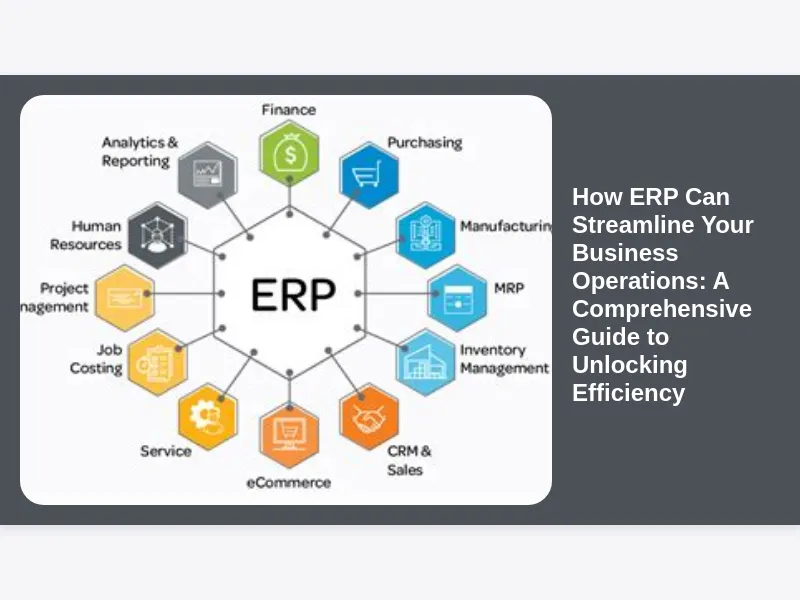
This is precisely where Enterprise Resource Planning (ERP) systems step onto the stage, not just as a software solution but as a foundational strategy for digital transformation. Imagine a world where every piece of information, every transaction, and every process within your company speaks the same language, sharing insights seamlessly across departments. That’s the promise of a well-implemented ERP system. It’s about moving beyond mere automation to achieving true operational harmony, allowing your business to flow like a well-oiled machine rather than a collection of disconnected parts.
Understanding the Core Problem: The Perils of Disjointed Systems
Before we dive into how ERP can streamline your business operations, let’s first acknowledge the common pitfalls most businesses face without it. Picture this: your sales team uses one CRM, your accounting department relies on a separate financial software, your warehouse manages inventory with spreadsheets, and HR has its own isolated system. Information flow becomes a game of telephone, riddled with inaccuracies and delays. Duplicative data entry is rampant, leading to errors and wasted time. Reporting is a nightmare, requiring hours of manual compilation from disparate sources, often yielding outdated insights.
This fragmentation isn’t just inefficient; it’s a significant impediment to growth and decision-making. Important strategic choices are made based on incomplete or old data, leading to missed opportunities or costly mistakes. Customer service suffers because no single employee has a holistic view of a customer’s interactions across sales, support, and billing. Supply chain disruptions become harder to foresee and manage because inventory levels aren’t accurately linked to sales forecasts or production schedules. Ultimately, disconnected systems create a fog that obscures your true operational capabilities and hinders your potential.
The Foundation of Efficiency: Centralized Data Management with ERP
At the heart of how ERP can streamline your business operations lies its unparalleled ability to centralize data. Think of an ERP system as the single source of truth for your entire organization. Instead of information residing in separate departmental silos, all critical business data—from customer orders and financial transactions to inventory levels and employee records—is unified within a single, integrated database. This fundamental shift eliminates the need for manual data reconciliation, vastly reduces errors, and ensures that everyone across your organization is working with the most current and accurate information available.
This centralized approach delivers immediate benefits. For instance, when a sales order is entered, inventory is automatically updated, a delivery schedule can be initiated, and an invoice is prepared – all linked and traceable within the same system. Financial reporting becomes real-time, reflecting the latest transactions as they occur. Supply chain visibility improves dramatically as you can track materials from procurement to production and delivery. This holistic view provides a powerful foundation for operational efficiency, fostering better collaboration and empowering more informed decision-making across all levels of your business.
Revolutionizing Financial Operations: Better Budgeting and Accounting
One of the most significant areas where how ERP can streamline your business operations truly shines is in financial management. Traditional accounting often involves separate ledgers, manual journal entries, and painstaking reconciliation processes. With an ERP system, financial data from sales, purchasing, inventory, and payroll automatically flows into the general ledger. This integration ensures that your financial records are always up-to-date and accurate, providing a clear and comprehensive view of your company’s financial health at any given moment.
Beyond basic accounting, ERP systems empower robust budgeting, forecasting, and financial analysis. You can easily generate custom reports, track expenses against budgets in real-time, and identify trends that might otherwise go unnoticed. This level of financial transparency and control is invaluable for strategic planning, allowing businesses to make proactive decisions about resource allocation, investment opportunities, and cost optimization. It transforms finance from a backward-looking function focused on reporting past performance into a forward-looking strategic partner guiding future growth.
Optimizing Supply Chain and Inventory: From Procurement to Delivery
The journey of a product, from raw materials to a satisfied customer, is a complex one. How ERP can streamline your business operations within the supply chain is by providing end-to-end visibility and control. An ERP system integrates procurement, inventory management, warehousing, and logistics into a single platform. This means you can track raw materials as they arrive, monitor work-in-progress, manage finished goods inventory, and even coordinate shipping and delivery – all from one centralized dashboard. This integration minimizes stockouts, reduces excess inventory, and optimizes your entire supply chain flow.
Consider the impact on inventory management alone. ERP can automate reorder points, forecast demand more accurately based on historical sales data and current trends, and even optimize warehouse layouts. This leads to reduced carrying costs, less waste, and improved cash flow. For procurement, the system can automate vendor selection, purchase order generation, and invoice matching, ensuring you get the best prices and maintain strong supplier relationships. By creating a transparent and efficient supply chain, ERP helps businesses deliver products faster, more reliably, and at a lower cost, directly impacting customer satisfaction and profitability.
Enhancing Customer Relationship Management (CRM): Boosting Sales and Service
While many businesses use standalone CRM systems, how ERP can streamline your business operations by integrating CRM functionalities (or connecting seamlessly with a dedicated CRM) is transformative for customer interactions. Imagine a scenario where your sales team can instantly see a customer’s order history, payment status, previous support tickets, and even inventory availability, all from one screen. This holistic customer view empowers them to provide personalized service, upsell relevant products, and resolve issues much more efficiently.
This integration means that customer data isn’t fragmented across different departments. A customer service representative can immediately see if a payment is overdue, if an order has been shipped, or if there’s a manufacturing delay impacting their delivery. This level of insight translates directly into improved customer satisfaction and loyalty. Furthermore, the sales pipeline can be managed more effectively, from lead generation and quoting to order fulfillment and invoicing, ensuring a smooth and consistent customer journey that drives repeat business and positive referrals.
Streamlining Human Resources and Payroll: Empowering Your Workforce
Managing human capital is a critical, yet often administratively heavy, aspect of any business. How ERP can streamline your business operations in HR and payroll involves automating many routine tasks and centralizing employee data. From onboarding new hires and managing employee information to processing payroll, benefits administration, and tracking time off, an ERP system consolidates these functions into a single, accessible platform. This significantly reduces manual paperwork, minimizes errors, and ensures compliance with labor laws and regulations.
Beyond the administrative efficiencies, an integrated HR module provides valuable insights into your workforce. You can track employee performance, manage training programs, analyze compensation structures, and even forecast staffing needs. This strategic approach to HR empowers management to make data-driven decisions about talent acquisition, development, and retention. By freeing up HR professionals from tedious administrative tasks, ERP allows them to focus on more strategic initiatives that foster a positive work environment and support employee growth, ultimately contributing to overall business success.
Boosting Manufacturing Efficiency: Production and Quality Control
For businesses involved in manufacturing, how ERP can streamline your business operations offers a profound competitive advantage. ERP systems provide comprehensive tools for managing the entire production lifecycle. This includes production planning, scheduling, capacity planning, bill of materials (BOM) management, work order management, and even quality control. By integrating these processes, manufacturers gain real-time visibility into every stage of production, from raw material procurement to finished goods assembly.
This level of integration allows for precise control over production schedules, minimizing bottlenecks and maximizing machine utilization. Quality control processes can be embedded directly into the workflow, ensuring that products meet specifications at every stage and reducing costly rework or recalls. Furthermore, ERP can track the cost of production with remarkable accuracy, helping manufacturers identify areas for cost reduction and improve profitability. The result is a more agile, efficient, and cost-effective manufacturing operation capable of meeting demand more reliably and producing higher-quality products.
Project Management Integration: From Conception to Completion
Many businesses, regardless of industry, rely heavily on project-based work. How ERP can streamline your business operations by integrating project management capabilities is often overlooked but incredibly powerful. An ERP system can centralize all aspects of a project, from initial planning and resource allocation to budget tracking, time management, and progress monitoring. This eliminates the need for disparate project management tools and spreadsheets, ensuring all project stakeholders are working with the same, up-to-date information.
This integration is particularly beneficial when projects involve cross-departmental collaboration, such as a new product launch that requires input from R&D, manufacturing, marketing, and sales. The ERP system can track project costs against budgets, allocate resources effectively across multiple projects, and provide real-time status updates. This leads to better project execution, timely delivery, and improved profitability, as potential cost overruns or delays can be identified and addressed proactively, ensuring projects stay on track and within scope.
Real-time Analytics and Reporting: Data-Driven Decisions
Perhaps one of the most transformative aspects of how ERP can streamline your business operations is its ability to provide real-time analytics and robust reporting capabilities. Because all your business data resides in a single, integrated database, ERP systems can generate comprehensive reports and dashboards that offer immediate insights into every facet of your operations. No more waiting days or weeks for compiled reports; the information you need for critical decisions is available at your fingertips, updated continuously.
This means you can monitor key performance indicators (KPIs) across sales, finance, inventory, and production in real-time. Identify sales trends as they emerge, pinpoint financial discrepancies instantly, or react quickly to supply chain disruptions. This level of data visibility empowers management to make truly data-driven decisions, shifting from reactive problem-solving to proactive strategic planning. It allows businesses to identify opportunities, mitigate risks, and optimize performance across the board, leading to greater agility and a significant competitive advantage.
Automation of Routine Tasks: Freeing Up Human Potential
A significant portion of how ERP can streamline your business operations comes from its inherent capacity for automation. Think about the countless repetitive, manual tasks that consume valuable employee time across various departments: generating invoices, processing purchase orders, reconciling accounts, updating inventory counts, or approving expense reports. An ERP system can automate many of these mundane processes, freeing up your human capital to focus on more strategic, creative, and value-adding activities.
This automation not only boosts efficiency but also dramatically reduces the likelihood of human error. For example, an ERP can automatically generate a purchase order when inventory levels drop below a certain threshold, or automatically send payment reminders to customers. This means your employees can shift from data entry and administrative chores to complex problem-solving, customer engagement, or innovation. The result is a more productive and engaged workforce, better utilization of talent, and a leaner, more agile operation that can adapt quickly to changing market conditions.
Scalability for Growth: Adapting to Future Needs
As your business grows, so does the complexity of your operations. A fragmented system that might have worked for a small startup quickly becomes a bottleneck for an expanding enterprise. How ERP can streamline your business operations is uniquely positioned to support this growth through its inherent scalability. A well-designed ERP system can easily accommodate an increasing volume of transactions, a growing number of users, and the addition of new departments, product lines, or geographic locations without requiring a complete overhaul of your IT infrastructure.
This means that as your business expands, your ERP system can scale with you, providing a stable and robust platform for continued growth. It can handle increased data loads, integrate new business units, and support new compliance requirements as you venture into new markets. This forward-looking capability provides peace of mind, knowing that your core operational system will not become an obstacle to your future ambitions but rather a fundamental enabler, allowing you to focus on market expansion and innovation rather than grappling with IT limitations.
The Journey of Implementation: Challenges and Considerations
While the benefits are clear, understanding how ERP can streamline your business operations also involves acknowledging the complexities of implementation. An ERP project is not merely a software installation; it’s a significant organizational change initiative. It requires careful planning, dedicated resources, and a clear understanding of your business processes. Common challenges include data migration from legacy systems, resistance to change from employees accustomed to old ways of working, and the potential for scope creep if project requirements aren’t clearly defined.
Successful implementation hinges on strong leadership, robust project management, and a commitment to communication throughout the process. It’s crucial to select the right implementation partner who understands your industry and business needs. Investing in thorough user training and change management strategies is also paramount to ensure high user adoption and maximize the return on your ERP investment. Addressing these challenges proactively will ensure a smoother transition and a more successful outcome, transforming potential hurdles into stepping stones toward operational excellence.
Choosing the Right ERP: On-Premise vs. Cloud and Specific Features
The market offers a diverse range of ERP solutions, and deciding which one is right for your business is a critical step in understanding how ERP can streamline your business operations for your specific context. A primary consideration is whether to opt for an on-premise solution, hosted on your own servers, or a cloud-based ERP, delivered as a service over the internet. Cloud ERP offers greater flexibility, lower upfront costs, and easier maintenance, making it a popular choice for many modern businesses. On-premise solutions offer more control and customization for specific industries with unique requirements.
Beyond deployment models, you’ll need to evaluate specific features and modules. Does the ERP offer robust financial management, supply chain, CRM, HR, and manufacturing capabilities tailored to your industry? Is it scalable enough to support your long-term growth? Consider the user interface and ease of use, as high user adoption is key to success. Don’t forget integration capabilities with other essential tools you might already be using. A thorough evaluation, often involving demos and a detailed needs analysis, is essential to select a system that aligns perfectly with your strategic goals and operational requirements.
Measuring the ROI of ERP: Tangible and Intangible Benefits
Investing in an ERP system is a significant financial commitment, so understanding how ERP can streamline your business operations also requires a clear focus on Return on Investment (ROI). The ROI isn’t always immediately apparent in a simple dollar figure; it’s a combination of tangible and intangible benefits. Tangible benefits include reduced operational costs (e.g., lower inventory carrying costs, reduced administrative overhead), increased productivity (e.g., faster order processing, automated tasks), improved cash flow, and reduced errors leading to less rework. These are quantifiable and directly impact the bottom line.
Intangible benefits, while harder to measure in exact terms, are equally crucial. These include improved decision-making due to real-time data, enhanced customer satisfaction from better service, greater employee morale resulting from simplified workflows, increased business agility, and a stronger competitive position in the market. Over time, these intangible benefits translate into sustained growth and long-term profitability. A comprehensive ROI analysis should consider both financial gains and strategic advantages, painting a complete picture of the value an ERP system brings to your organization.
The Future of ERP: AI, Machine Learning, and IoT Integration
The evolution of how ERP can streamline your business operations is continuous, with emerging technologies reshaping its capabilities. Artificial intelligence (AI) and Machine Learning (ML) are becoming increasingly integrated into ERP systems, moving beyond simple automation to predictive analytics and intelligent decision support. Imagine an ERP system that not only tells you your current inventory levels but also predicts demand fluctuations based on market trends and automatically optimizes reorder points using AI algorithms. This intelligent layer transforms reactive processes into proactive strategies.
Furthermore, the Internet of Things (IoT) is increasingly linking physical assets to ERP. Sensors on machinery can feed real-time performance data into the ERP, enabling predictive maintenance, optimizing production schedules, and improving asset utilization. Blockchain technology is also gaining traction for enhancing supply chain transparency and traceability. These advancements promise an even more interconnected, intelligent, and autonomous operational environment, positioning ERP at the forefront of digital transformation and ensuring businesses remain competitive in an ever-evolving technological landscape.
Employee Adoption and Training: Crucial for Success
Even the most sophisticated ERP system will fail to deliver on its promise if your employees aren’t willing or able to use it effectively. Therefore, understanding how ERP can streamline your business operations must include a strong emphasis on user adoption and comprehensive training. People naturally resist change, especially when it involves fundamental shifts in their daily routines and workflows. It’s imperative to communicate the “why” behind the ERP implementation – how it will benefit them personally, not just the company. Involve key users in the planning and testing phases to foster a sense of ownership.
Thorough training programs, tailored to different roles and departments, are non-negotiable. This isn’t a one-time event but an ongoing process, including initial training, refresher courses, and access to support resources. Providing clear documentation, online tutorials, and a dedicated support team can significantly ease the transition. When employees feel confident and comfortable navigating the new system, they become champions of the change, unlocking the full potential of the ERP and truly leveraging its power to streamline operations.
Security and Compliance: Protecting Valuable Data
In an era of increasing cyber threats and stringent data regulations, how ERP can streamline your business operations also entails robust security and compliance measures. An ERP system centralizes all your critical business data, making it a prime target for cybercriminals if not adequately protected. Therefore, security must be a top priority during selection and implementation. This includes strong authentication protocols, role-based access controls to limit data visibility, regular security audits, and comprehensive data encryption both in transit and at rest.
Beyond security, ERP systems play a vital role in ensuring regulatory compliance. For industries subject to specific regulations (e.g., financial services, healthcare, pharmaceuticals), an ERP can help automate compliance tasks, maintain audit trails, and generate reports required by regulatory bodies. This reduces the risk of penalties, legal issues, and reputational damage. By embedding security and compliance into the very fabric of your operational system, ERP provides a robust framework that not only streamlines processes but also safeguards your most valuable asset: your data.
Real-World Impact: ERP in Action (Conceptual Examples)
To truly grasp how ERP can streamline your business operations, let’s consider a couple of conceptual scenarios. Imagine a rapidly growing e-commerce company struggling with manual order processing, leading to shipping delays and customer complaints. Implementing an ERP system allows them to automate order entry, instantly update inventory, trigger warehouse picking, and generate shipping labels. Result: orders are processed 50% faster, shipping errors drop by 80%, and customer satisfaction soars, enabling them to handle triple the volume with the same staff.
Or consider a mid-sized manufacturing firm dealing with frequent stockouts of raw materials and inefficient production scheduling. Their ERP integrates sales forecasts directly with production planning and procurement. The system now automatically flags potential material shortages, suggests optimal production runs based on machine availability, and generates purchase orders for critical components. Consequence: stockouts are virtually eliminated, production lead times decrease by 30%, and overall manufacturing costs are reduced by 15%, making them far more competitive and profitable. These aren’t just hypothetical improvements; they are common outcomes of successful ERP adoption.
The Transformative Power of ERP: A Strategic Imperative
In conclusion, understanding how ERP can streamline your business operations is about recognizing its profound transformative power. It’s far more than just a software suite; it’s a strategic platform that integrates and optimizes every core function of your business. From centralizing data and automating routine tasks to providing real-time analytics and ensuring compliance, ERP creates a cohesive, efficient, and agile operational environment. It breaks down silos, enhances collaboration, and empowers your workforce to focus on value-added activities.
The benefits are clear and compelling: improved financial management, optimized supply chain, enhanced customer experiences, greater manufacturing efficiency, and the scalability required for sustainable growth. While implementation requires commitment and careful planning, the long-term rewards—in terms of productivity, profitability, and competitive advantage—are undeniable. Embracing an ERP system is not just an IT project; it’s a strategic imperative for any business looking to navigate the complexities of the modern market and unlock its full potential for operational excellence and sustained success.
References & Further Reading (Conceptual Placeholder Links):
- Gartner: https://www.gartner.com/en/information-technology/software/erp (For industry reports and market insights on ERP)
- Forbes: https://www.forbes.com/erp (For business perspectives on ERP adoption and benefits)
- Deloitte Insights: https://www2.deloitte.com/insights/us/en/focus/industry-4-0/erp-modernization.html (For insights on ERP and digital transformation)
- TechTarget: https://searcherp.techtarget.com/definition/ERP (For comprehensive definitions and technical explanations)
- SAP: https://www.sap.com/mena/products/erp/what-is-erp.html (A leading ERP vendor’s perspective on the technology)